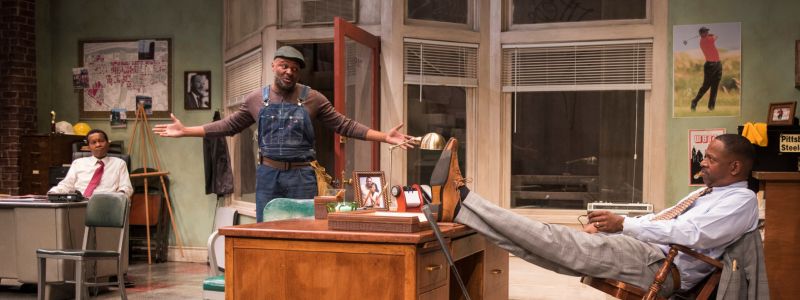
Harmond Wilks shows his wife Mame around his new construction office. She dislikes his plans to put a campaign office down the street, saying that the neighborhood is not appealing. Harmond says that the symbolism of having his offices in a Black neighborhood matters.
Harmond and his friend and business partner Roosevelt discuss work and golf. Sterling Johnson, a former classmate, enters the office. He shares that he robbed a bank many years before, and he now works in construction. Roosevelt tells Harmond that someone is painting a house that they are planning to knock down.
Old Joe has a scattered conversation with Harmond, who is trying to get back to work. Joe seems to have lived a colorful life. They liken America to a broken slot machine—Harmond says it can be fixed, and Old Joe thinks they need a whole new machine. He says that if Harmond wins his election for mayor, they will only give him half the keys.
Roosevelt tells Harmond that it was Old Joe who was painting the abandoned house, using Sterling as a contractor. He threatens Joe with legal action, but Old Joe insists that the house is his, since his mother bought it in 1925. Harmond gets Old Joe’s legal summons dismissed, but tells him that neither Joe nor his daughter can live there. Old Joe accuses Harmond of not caring about the little man.
Roosevelt is excited about a long overdue promotion at the bank, and a golfing invitation with a well-connected white man named Bernie Smith.
Mame and Harmond argue about a speech of his that the paper is publishing. Mame wants him to cut a remark about police brutality from the published version in order to retain support from the police union; Harmond wants his speech published in full. Old Joe returns and discusses God with Mame. Harmond’s golf clubs have been stolen. He insists to Old Joe that he cannot live in the house.
Roosevelt returns from his golf game, ecstatic. He was approached by Bernie Smith to buy a radio station together. Harmond is deeply skeptical of the proposal and says that Roosevelt is being used so Smith can access minority tax breaks. Roosevelt says this is his way in the door.
Mame has been offered a public relations job in the governor’s office. Sterling congratulates Harmond on his mayoral candidacy. Sterling, Harmond, and Old Joe talk about the American flag and those they knew who died for it. Old Joe shares that Harmond’s father had been paying the taxes on the abandoned house.
Harmond tells Roosevelt that Old Joe Barlow’s house, 1839 Wylie, was illegally purchased by their company. He wants to compensate Old Joe for the loss. They learn that the city officially declared “blight,” meaning that city funding will be available for their project. Sterling comes in frustrated after finding the newly painted door at 1839 Wylie defaced. He demands to be compensated for his work. Harmond gives him $26 and says they are tearing the house down. Sterling argues back; Old Joe Barlow had hired him to do the painting. Sterling says if they tear down the house, they will have to answer to him. Harmond gives Old Joe a check for his home, but Joe doesn’t want it; he wants his house. Sterling tells Harmond that he stole Old Joe’s house, which is not a good look for his campaign.
Roosevelt has quit his job at the bank. Harmond has new renderings of the development project that include 1839 Wylie Avenue. Harmond reveals to Old Joe that they are not demolishing the house. The two men realize they are related: Old Joe’s mother was the half-sibling of Harmond’s grandfather.
Mame and Roosevelt are worried about Harmond. Roosevelt has rescheduled the demolition, and Mame says that he is throwing away his career. Roosevelt reads off Old Joe’s rap sheet, but Harmond remains convicted. He will file an injunction to stop the demolition.
The house’s fate hangs in the balance, as do Mame’s and Harmond’s careers. Roosevelt and Sterling argue, with Sterling saying that Roosevelt is sucking up to white people. Roosevelt reveals that the injunction was denied by a judge and the house will be knocked down. Harmond is incensed by the tiny increments of supposed “progress” that make people blind to the ongoing impact of racism. Roosevelt says he is buying Harmond out of the development business, and Harmond says that Roosevelt isbeing backed and used by the white man. The two part ways.
Radio Golf takes place in the Hill District in Pittsburgh, Pennsylvania in 1997. Specifically, it’s set in the office of Bedford Hills Redevelopment, Inc., in a storefront on Centre Avenue.
Place in August Wilson’s American Century Cycle
Radio Golf is the tenth play chronologically in August Wilson’s Century Cycle, taking place in the 1990s. It was written in 2005 and produced at Court Theatre in 2018.
A Note for Teachers
This play contains racial slurs. Please prepare students accordingly.