Post-Show Classroom Activity
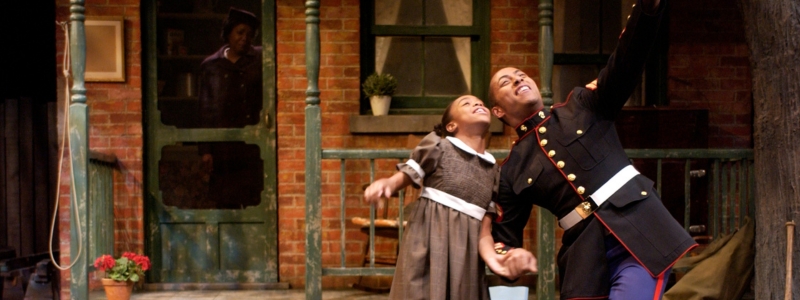
Invite students to reflect on August Wilson’s epigraph in Fences.
As always, please note that some steps of the activity may be condensed, eliminated, or extended based on the needs of your classroom.
The Sins of Our Fathers
Activity Preparation
- Supplies
- Sins of Our Fathers handout (1 per student)
- Access to a dictionary (print or digital)
- Set-Up
- Step 1 guides students through an exploration of the word epigraph. This step is optional.
- This activity presumes that students have an understanding of certain forms of literary devices, such as personification, simile, and repetition. If students are not familiar with these concepts, introduce them first.
- Students will be working independently, in pairs, or in groups of four during this activity. Group students thoughtfully to support learning and discussion.
- Step 7 suggests two one-word topics as a starting point for students to craft their figurative language: fathers and forgiveness. Determine whether to provide both of these prompts to the whole class, allowing them to combine or select one to use, or whether to split the class and have half use each prompt.
This activity will take approximately 50 minutes
Learning Sequence
- (Optional) Ask: What is an epigraph? Invite students to share their ideas. If students are not familiar with the word, take a few minutes to help them break it down into its roots. Share that epi- means “on” and is a common prefix in medical vocabulary, like epidermis and epinephrine. Ask students to brainstorm words that contain –graph. They may come up with words like autograph, graphic novel, geography, graphite, photograph, etc. If students are struggling to determine the meaning of this root, share with them that it means “to write.” Then, share the definition of epigraph: a quotation included at the beginning of a literary work that usually references its theme. (~5 minutes)
- Share that many editions of August Wilson’s play Fences include an epigraph. Tell students that this activity will guide them through a poetic analysis of this epigraph. (~1 minute)
- Direct students to Part 1 of the Sins of Our Fathers handout. Read or ask a student to read the epigraph twice. Guide students to independently annotate for unfamiliar words. Give them an opportunity to look up these words in a dictionary. (~2 minutes)
- Ask: How does this epigraph relate to the plot, characters, and theme of Fences? (~5 minutes)
- Have students annotate their texts independently for one or two words or phrases they find especially striking. (~2 minutes)
- Pair students and have them work together to locate and classify the literary devices that they see. Responses may vary, but students are likely to recognize simile, repetition, and personification. Instruct them to annotate their paper for each literacy device, making note of the impact of each example. Invite students to share their ideas with another pair or aloud with the class. (~5 minutes)
- For the next steps in the activity, “square up” pairs so that students are working in groups of four. Direct them to Part 2 of the handout. Tell the class that they will work collaboratively to build a poem out of single lines that individual students craft. Provide them with a one-word topic to use as inspiration: fathers or forgiveness. (~1 minute)
- Prompt students to individually write one or two lines that includes either a simile, repetition, or personification about their topic. Once students have written their own line, direct them to share their lines with their groups. Then, have each group of four arrange their lines into one or two stanzas of poetry. (~10 minutes)
- Give each group a chance to copy the entire stanza onto each of their handouts. Then, have each group of four exchange one of their handouts with another group (or groups). Prompt them to order the stanzas they have into a poem. (~5 minutes)
- Point out that in this August Wilson epigraph, there are periods, a comma, and select capitalization. With their newly built poems, direct groups to work together to insert one or all of these text features, or one or more of their own choosing (e.g. other punctuation, bolding or italics, etc.). (~5 minutes)
- Prompt students to discuss: What effect does this order of stanzas have on the tone or story established in the poem? What impact do your text features have? What is this poem saying about the topic? (~5 minutes)
- As time allows, invite students to share their work and reflections. If possible, do so by projecting each poem so their classmates can see the text features and follow along with the reading. (~5 minutes)
- This activity aligns with the following standards:
- Illinois Arts Learning Standards
- Anchor Standard 1: Generate and conceptualize artistic ideas and work.
- Anchor Standard 2: Organize and develop artistic ideas and work.
- Anchor Standard 7: Perceive and analyze artistic work.
- Anchor Standard 10: Synthesize and relate knowledge and personal experiences to make art.
- Common Core State Standards
- CCSS.ELA.R.1: Read closely to determine what the text says explicitly and to make logical inferences from it; cite specific textual evidence when writing or speaking to support conclusions drawn from the text.
- CCSS.ELA.L.4 Determine or clarify the meaning of unknown and multiple-meaning words and phrases by using context clues, analyzing meaningful word parts, and consulting general and specialized reference materials, as appropriate.
- CCSS.ELA.L.5 Demonstrate understanding of figurative language, word relationships, and nuances in word meanings.
- CCSS.ELA.SL.1 Prepare for and participate effectively in a range of conversations and collaborations with diverse partners, building on others’ ideas and expressing their own clearly and persuasively.
- Illinois Arts Learning Standards