Behind the Scenes: Scenic and Costume Design for Miss Julie
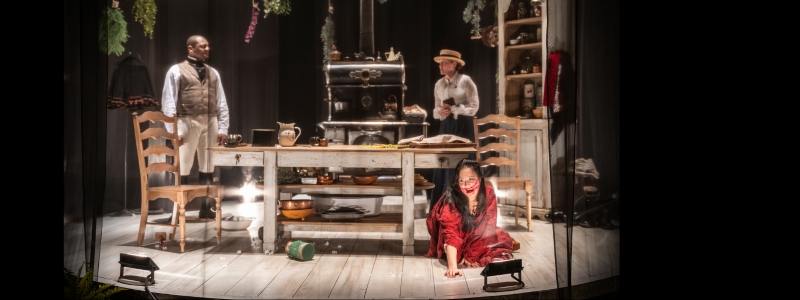
August Strindberg’s Miss Julie is a cage match: volatile, intimate, and impossible to escape. That sense of danger and claustrophobia is amplified by the production’s striking visual world, created by Scenic Designer John Culbert and Costume Designer Raquel Adorno. Below, they reveal the inspirations behind the designs that bring the play’s simmering tension to life.
Read on to learn more!
Scenic Design
John: I often start the design process with literal research: Where are we? In Miss Julie, we’re in a manor house in Sweden. Manor houses are country houses, generally owned by well-to-do families (or, in this case, formerly well-to-do and perhaps now less well-to-do). Early on, we developed a metaphorical image for the world of this play, which is a stove or hearth, symbolic of family, connection, and sustenance. The stove is placed in a garden, and it’s not just any garden; this is a garden on Midsummer Eve, so there’s a magical quality about it. The metaphor of the stove in the garden served as a throughline for the world of the play. What’s typically set inside is now outside, and thus exposed.
The notion of a verdant, mossy garden became important to our world. Then our thinking gravitated to capturing the atmosphere of a garden, with a Midsummer feel, where light is an important element in creating the magic. We responded to representations of a garden that aren’t literal, that are more atmospheric.
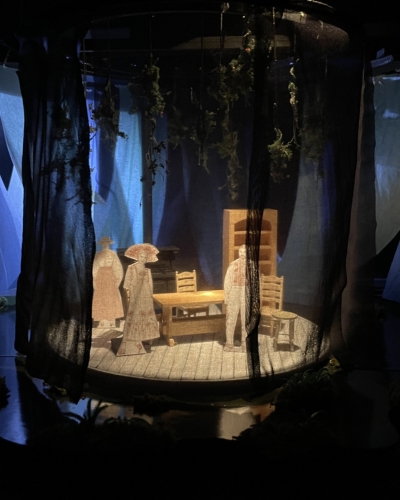
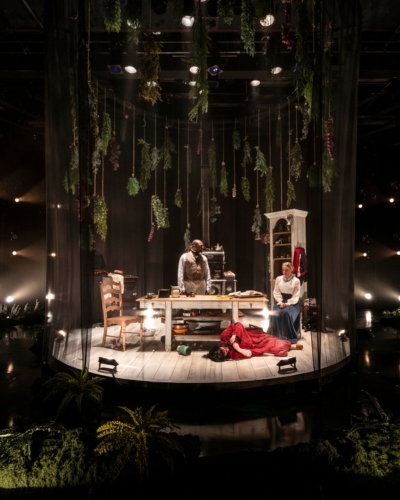
All of this led us to this model—we have a suggestion of a mossy garden around the central platform, and a huge cast-iron stove on the platform. And there’s not much else in the “kitchen”. There’s a table, a cupboard, and some chairs. Another visual reference to the garden concept is the ring of hanging herbs that surrounds the kitchen. As cut-off plants, they represent an amputated garden—their life cut short.
There’s a gauzy fabric surrounding the kitchen, separating us, the audience, from the intimate activity of the characters, thus making us voyeurs into their world. We are experiencing intimate life moments we should not be seeing. The “cage” of fabric is also their birdcage, trapping them and representing their inability to escape their societal roles.
Our goal for this world was to create an intimate and private space where the characters cannot escape or avoid each other. They must confront their circumstances. It also creates a canvas for light to create an ever-changing atmosphere to intensify the dramatic tension.
Costume Design
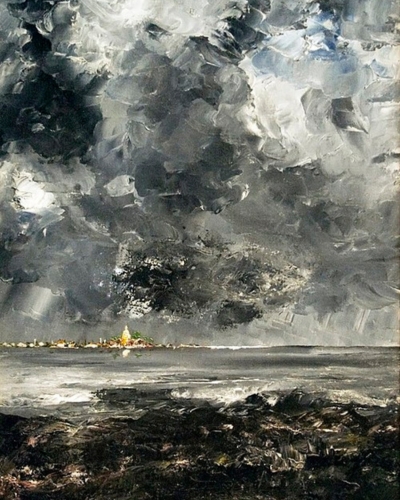
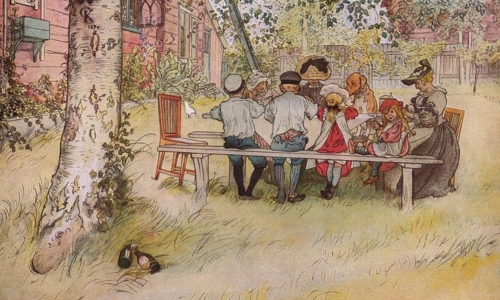
Raquel: The costume design for this production of August Strindberg’s Miss Julie at Court Theatre seeks to capture the liminal, hallucinatory atmosphere of Midsummer, where the rigid social hierarchies of the 1880s dissolve into the feverish intensity of the Solstice. This visual world is a collision between the sun-drenched, idyllic domesticity of Carl Larsson’s illustrations and the turbulent, psychological landscapes of Strindberg’s own expressionistic paintings. As the night progresses, crisp reds, blues, yellows, and whites shift toward the earthier tones of the kitchen and the herbal tea Kristine is brewing because, really, the tea is the thing.