Post-Show Discussion Activity
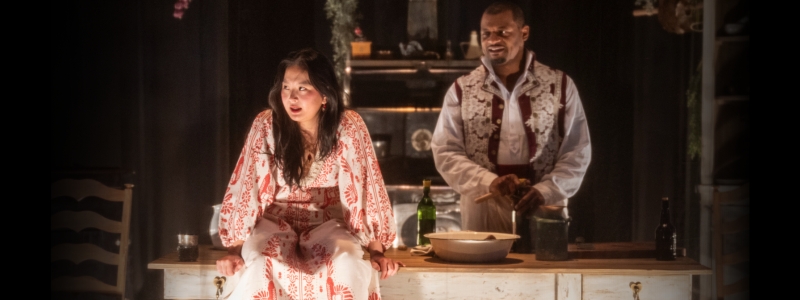
Use these questions to reflect, discuss, or journal about your experience and reactions to Miss Julie! Explore any of the questions that interest you.
If engaging in this activity independently, consider taking notes or writing your reflections down. If engaging in this activity with a class or group, decide if you would like to answer every question in order, skip around, or select certain questions to spend time on.
Discussion Questions
- Jean and Miss Julie both share recurring dreams early in the play. What do these dreams represent?
- What are the key points at which the power dynamics shift between Miss Julie and Jean? What manipulations and power plays work best?
- What story does the set tell?
- Consider the two animals that Miss Julie is concerned about: her dog, Diana, and her bird. What contrast do these animals offer? What do each of these animals symbolize?
- This play is considered the prime example of Naturalism in theatre, and Strindberg was fascinated by treating his characters like figures in a science experiment, with constants and variables clashing. How does the Naturalism movement, and this play in particular, invite science into the world of the stage?
- Consider Kristine. What kind of person is she? What role does she serve within the play? Does she really love Jean?
- This play takes place in something of a magical time: the one evening a year when the sun never sets. How does the backdrop of this Swedish holiday set the tone of the play?
- In the original Miss Julie script, the final moments of the play imply that Miss Julie will end her own life. How does the ending of Court’s production differ? What story or meaning is layered onto the play with this new interpretation?
- This play is originally inspired by a fairy tale, The Swineherd. Though many fairy tales are geared towards children, they are often full of dark themes and plot points. How and when do fairy tales and horror stories collide? When do (or must?) they exist in the same story?
- Who is more at risk in the dangerous game they play of crossing boundaries — Jean or Miss Julie? Who pushes boundaries more? When do deference and danger, manipulation and desire blend together?
- This play has been produced every year since it was written. Why does this story endure?
- This activity aligns with the following standards:
- Illinois Arts Learning Standards
- Anchor Standard 7: Perceive and analyze artistic work.
- Anchor Standard 8: Construct meaningful interpretations of artistic work.
- Anchor Standard 11: Relate artistic ideas and works with societal, cultural, and historical context to deepen understanding.
- Common Core State Standards
- CCSS.ELA.SL.1 Prepare for and participate effectively in a range of conversations and collaborations with diverse partners, building on others’ ideas and expressing their own clearly and persuasively.
- CCSS.ELA.RL.3 Analyze how and why individuals, events, and ideas develop and interact over the course of a text.
- Illinois Arts Learning Standards