Glossary
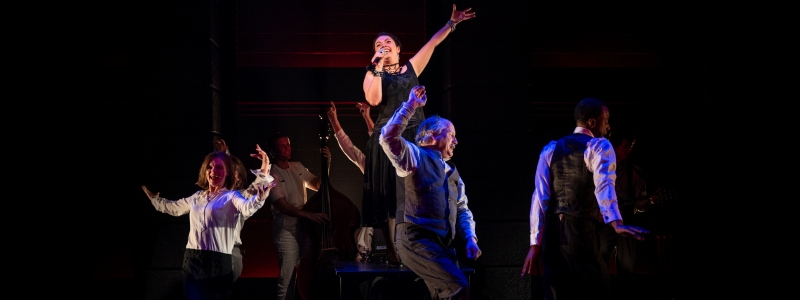
This glossary includes helpful vocabulary and references that will deepen your understanding of the words and world of Berlin.
| WORD/PHRASE | DEFINITION |
|---|---|
| Ach meine liebe Fraulein | (German) Giving you a proper shoe shine. |
| AIZ | (n) Arbeiter-Illustrierte-Zeitung or The Workers Pictorial Newspaper, the AIZ was a pro-Communist, anti-fascist magazine published in Berlin between 1924 and 1933 |
| Armistice | (n) A truce; an agreement to stop wartime fighting |
| Berliner | (n) A local dialect called Berlinerisch or Berlin German |
| Bleib hier. Du bleibst jleich hier bei mir. | (German) Stay here. You stay right here with me. |
| Bourgeoisie | (n) The capitalist class who own most of society’s wealth and means of production |
| Buchenwald | (n) AGerman Nazi concentration camp; Nazi “doctors” conducted human experiments on prisoners, injecting them with typhoid |
| Carl von Ossietzky | (n) A journalist who exposed Germany’s rearmament, where the country violated the terms of the Treaty of Versailles by stockpiling weapons; Ossietzky won the Nobel Peace Prize and was later arrested and imprisoned in a concentration camp |
| Cornet | (n) A brass instrument similar to a trumpet |
| DDR | (n) The Deutsche Demokratische Republik or German Democratic Republic, a socialist state that existed from 1949 to 1990 in the Soviet-occupied zone of Germany/West Germany |
| Dentifrice | (n) Toothpaste |
| Du würst meen Uffpassa, meen Jängsta | (German) You’ll be my bodyguard, my gangster |
| Ernst Thälmann | (n) A German politician and leader of the communist party (KPD) |
| Harry Houdini | (n) An Hungarian-American illusionist and stunt performer, 1874-1926. |
| Herkules | (n) A brand of beer. |
| Horns | (n) Referencing propaganda illustrations likening Jewish people to devils |
| Joseph Goebbels | (n) Chief propagandist of the Nazi party, responsible for vilifying Jews and other groups targeted by Nazis |
| Josephine Baker | (n) An American-born French dancer, singer, and actress, and one of the most successful Black performers in French history |
| Karl Zörgiebel | (n) A German politician and police official |
| Komme rin | (German) Come into me. |
| Konnte man dummer sein, langsamer, mehr wie eine dumme Kuh? | (German) Could you be more stupid, more slow, more like a stupid cow? |
| KPD | (n) Kommunistische Partei Deutschlands, the Communist Party of Germany |
| Mädchen | (German) Girl |
| May Day | (n) The first of May, also known as Labor Day or International Workers Day, is a celebration of workers’ rights and the labor movement |
| Orpheus | (n) In Greek mythology, Orpheus was a poet and prophet; he famously went to Hell to retrieve his wife, Euridyce, but upon turning back to look at her, she was snatched back to Hell forever |
| Potsdamer Platz | (n) The heart of Berlin, which in the 1920s was buzzing with shopping, traffic, and entertainment |
| Prost! | (German) Cheers! |
| Red | (n) A slang term for a communist |
| Reichstag | (n) The German parliament |
| Rosa Luxemburg | (n) A Polish and naturalised-German revolutionary and Marxist theorist; she was arrested, tortured, and then executed alongside Karl Liebknecht in 1919 and her body was dumped into the Landwehr Canal |
| SA | (n) Sturmabteilung or “Storm Detachment”; the original paramilitary group under Hitler’s Nazi party in the 1920s and early 1930s |
| Shupo | (n) The uniformed police force of Nazi Germany |
| Sisyphus | (n) From Greek mythology; he was punished for eternity by having to roll a boulder up a mountain, only to have it roll back down when he got to the top |
| Spree | (n) A river in Berlin |
| Sturmlokale | (n) Bars or pubs that serve as meeting places for the SA, or a Nazi paramilitary group |
| Tiergarten | (n) A city park in Berlin |
| Versailles | (n) Reference to the Treaty of Versailles, which officially ended WWI; in the treaty, Germany was made to take blame for the war, reduce the size of their army, concede land, and pay reparations |
| Wir machen dit so | (German) Let’s do it this way |
| Zeppelin | (n) A rigid airship |