Behind the Scenes: Scenic and Costume Design for The Taming of the Shrew
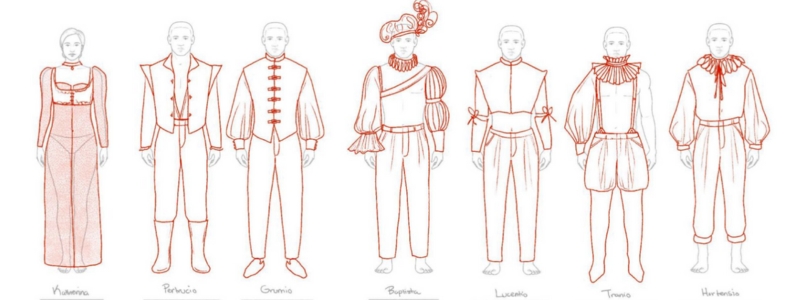
Shakespeare’s The Taming of the Shrew, adapted and directed by Marti Lyons, is lush, sexy, and evocative. It’s a visual feast, a theatrical experience that awakens all of your senses, and that is in no small part thanks to Scenic Designer Jackie Fox and Costume Designer Kotryna Hilko‘s unique artistic visions.
Below, Jackie and Kotryna shed light on their processes, their inspirations, and how their designs brought Lyons’s bold interpretation to life. Read on to learn more!
Scenic Design

Jackie: When thinking about the set for The Taming of the Shrew, we started with the question of, “What did Shakespeare do?” The Wanamaker Theatre [in England] was initially interesting to us; the space lends itself to the question of who is watching whom, and where there are opportunities for seeing. For us, this production has always been about who has the opportunity to observe, and who is being observed, at any given moment. After exploring these ideas in many iterations, we came to the table and realized, “Right…but we’re in Italy.” And Max [Maximo Grano De Oro], the Lighting Designer, said Shakespeare—or any of the people seeing this play when it was first produced, for that matter—wouldn’t have known what Italy would have looked like at that time, so we get to extract the idea of Italy. After that, I started looking at how the Italians did Renaissance theatre, and I compared the two spaces, English theatres and Renaissance theatres.
There’s this sense of grandeur in these Renaissance spaces, a sense of Italian money, that’s so clear in this imagery; there’s so much color, so much texture, so much grandeur. When boiling it down, that meant marble, that meant tile, that meant archways. We always knew that we were going to be at Court Theatre—we weren’t pretending that we’re traveling somewhere, or that this could be any theatre, anytime, or any place—so how do we capture that sense of lushness in this space, specifically? What does lushness feel like? I knew that I didn’t want to add too much greenery to the space because we had discussed the parts of our world that are tamed and those that are not, and I knew that the set wanted to live inside the landscape of being extremely tamed. People had built these spaces, and they had built them to look perfect, so I found all this imagery of different frescoes and Renaissance tapestries to reflect the element of lushness.
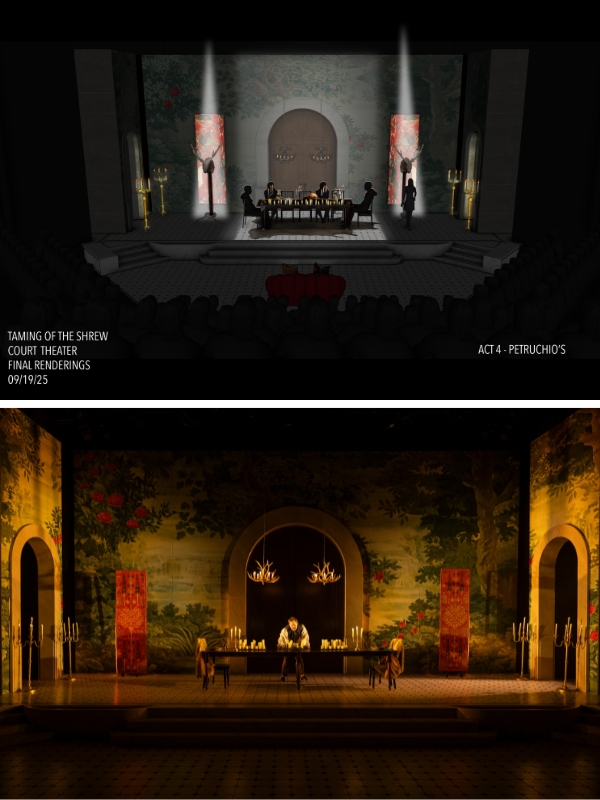
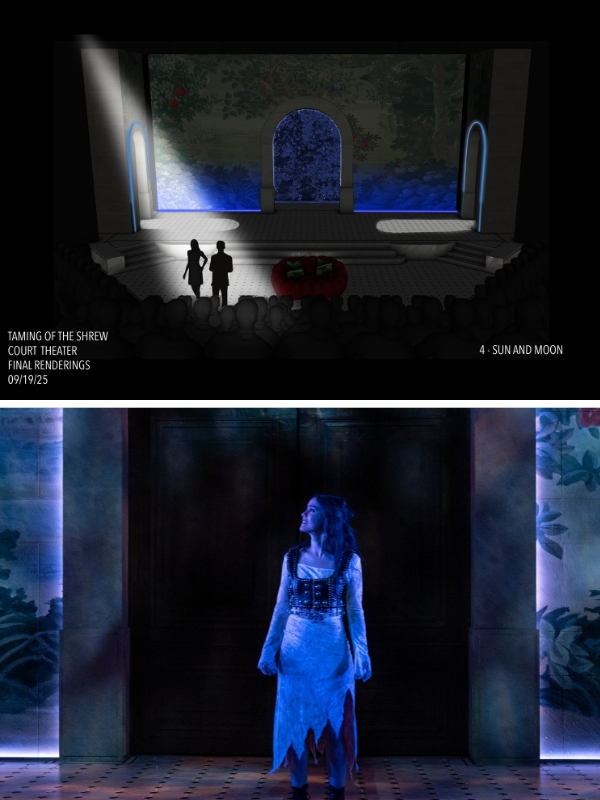
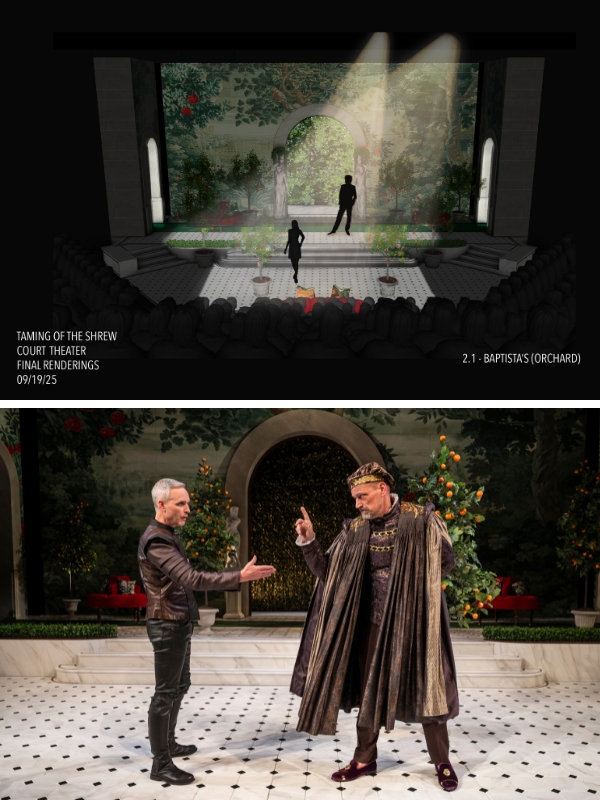
The deck is all marble tiling, and on stage left and stage right, there are these planters that allow for dimensional change visually as we shift location. All the walls have a sandstone-style texture on them, and we see the archways pulled from Renaissance Italy. When we’re in Baptista’s house, we have this clean marble, these stately statues, and this huge carpet that feels so lush and luxurious. All these elements make us feel like we’re inside a luxurious interior. The thing that’s most exciting to me is this great mural that has been curated and painted onto the walls. Finally, a curtain tracks in and out from the center that helps us bifurcate the space and allows for some exciting reveals.
To establish the orchard, the upstage doors open, revealing an upstage wall that is covered in ivy, and a slew of trees come onstage that simultaneously create obstructions and pathways. In another dramatic reveal, we open the doors and curtain, add a table and some new tapestries, and we’re transported to Petruchio’s home. The goal is to evoke a medieval hunting lodge; this is a place where nature has been tamed, but in a rougher and more rustic way. It’s rough around the edges. The long table in the center is covered in candles; the idea of flame and firelight is really important to the imagery of this scene. Once we reach the “sun and moon scene” (in act 4, scene 5), we have a totally bare stage for the first time in this whole play. This scene is an opportunity for us to invite in some magic, and Katherina and Petruchio have a little more control over how this space reacts to them during this moment. By the end, we purposely end up with a lot of the trappings that we saw earlier in the play to demonstrate how all of these people are sort of the same around the edges, but they’re each responding differently to The Shrew Experience.
Costume Design
Kotryna: Our play begins with these two couples—Lady K and Lord K, and Lady B and Lord B —and Lady B’s assistant, Chris Sly, who have signed up for an immersive theatre experience called The Shrew Experience. They’ve come for what they think is going to be an exclusive night of theatre, but things get twisted throughout the evening.
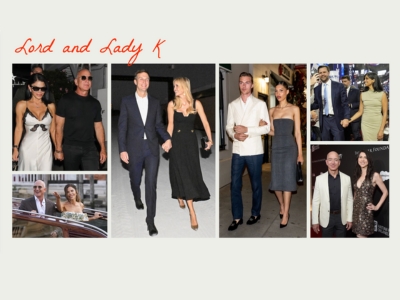
At the top of the play, in the Induction, these couples are going out for a fun and flirty date night. Lord K is a tech executive, and Lady K feels like she used to be a political fixer, but has left her job to support her husband’s career. Lady K was inspired by Lauren Sanchez, Huma Abedin, and Melania Trump, while Lord K was inspired by Jeff Bezos and Elon Musk. For Lord B, we were inspired by JD Vance and other political players in the Republican party, while Lady B was inspired by Nara Smith and other tradwife influencers. Chris Sly, Lady B’s assistant, is inspired by Giancarlo Granada, who was caught up in the Becki and Jerry Falwell scandal.
In the Induction, the men are dressed in comfort luxury, while the women are dressed for the male gaze. Lady K’s outfit feels a little more business-oriented, with kink undertones in the leather, while Bianca is in a Chanel-inspired look and a day collar, which is an accessory that some in the tradwife movement wear to show submission to their husbands.
Then we get into The Shrew Experience. The Shrew Experience has been designed to allow exclusive clients a chance to live out a fantasy and star in a Shakespearean play. I knew it wanted to feel like an Instagrammable luxury experience, so I began by researching Elizabethan and Italian Renaissance clothing and how these period pieces have been reinterpreted through a modern lens, pulling inspiration from the runways of Dolce & Gabbana, Oscar De La Renta, Valentino, and Palomo. As The Shrew Experience falls apart, we see the period pieces fall away and transform.
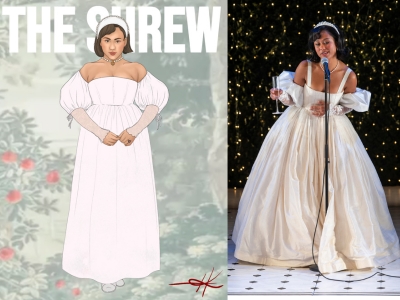
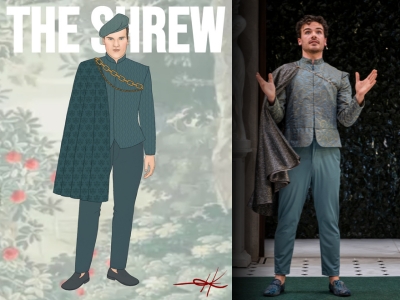
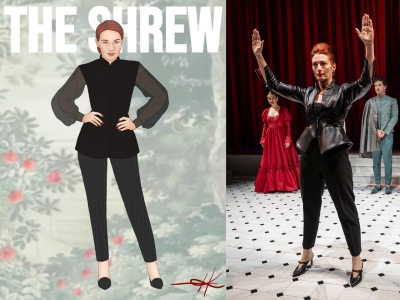
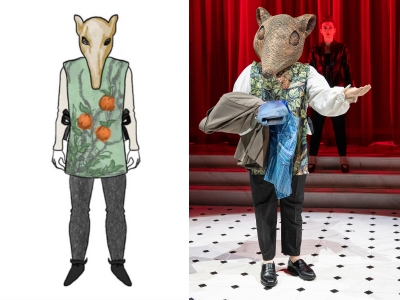
The final element of The Shrew Experience was the masks we had custom-built for our production. In the design process, we were constantly questioning who the shrew really was in the play, and we realized we loved the idea of seeing shrews on stage. Whenever the crew or actors appear on stage, not in character, they appear in masks and tunics that block their identity and transform them into neutral little shrews that make this world come to life.
2 responses on “Behind the Scenes: Scenic and Costume Design for The Taming of the Shrew”
Comments are closed.
need costumes shown on web
Thank you for this feedback! While we have some costumes included in the blog post, we encourage you to check out our production photos for a more in-depth look: https://www.courttheatre.org/season-tickets/1996-1997-season/the-taming-of-the-shrew/gallery/production-photos/