Anthropological Anti-Structure
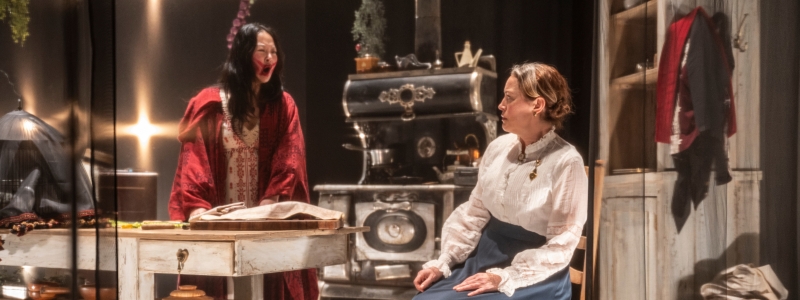
Learn more about Victor Turner’s concept of “anti-structure” and consider some questions about Miss Julie through this framework. Thanks to Lee Gutman, Univserity of Chicago student and member of the Court Theatre Dramaturgy Cohort, and Marissa Fenley, Literary Fellow, for this background!
Victor Turner: Liminality and Communitas
Victor Turner (1920 – 1983) was a British anthropologist who studied rituals and symbols. While living with the Ndembu people of current-day Zambia, he studied their rites of passage, rituals that mark the change from one state to another (e.x., coronation, which changes an heir to a monarch). He disagreed with the common idea that rites were just functional components of everyday society. Instead, he thought they were “anti-structure,” allowing people to create new ways of interacting outside of normal rules. He took inspiration from experimental theatre and performance studies, and in turn the field often drew upon his work.
Two important parts of Turner’s theory of ritual anti-structure are liminality and communitas. You may have heard the term “liminal space” referring to spaces used for movement and waiting, especially the ones where time seems to be suspended and there are less “rules” for behavior. Airports and doctors’ waiting rooms are examples of those kinds of places. Similarly, anthropologists before Turner used liminal to refer to the intermediate stage during a rite of passage; for example, the part of a coronation where the person is no longer an heir but not yet a monarch. Turner broadened it to refer to the general “in-between” state of a rite, during which no one occupies their normal social role. Just as the heir is not a king, the commoner stops being a subject. Liminality creates communitas, a state of solidarity and togetherness among participants. The word “community” normally refers to members of a society who behave according to its rules, but Turner uses the Latin word “communitas” to refer specifically to direct interactions between people, unobstructed by any norms. He believed that during these moments, people recognized each other’s “humankindness” and fundamental equality. Although communitas requires liminality and therefore can only occur outside the normal structure of society, it is ultimately necessary for upholding it by creating its underlying emotional connectivity.
- Over the course of the play, as Julie and Jean leave their normal roles of mistress and servant, do they abandon that structure entirely, or do they just invert it? Can you identify liminality in any particular moments of transition between roles?
- Although Julie and Jean certainly interact outside the normal restrictions of society, to experience communitas they must also recognize their equal humanity. Do Julie and Jean ever recognize one another as equals? Does one and not the other, or do they do so at different times?
- As Julie and Jean shift, Kristine appears determined not to change. Do you think she ever steps outside her social role? If so, where? If not, what actions does she take to hold on to her role in society while the society around her falls apart?
- While Julie and Jean have tumultuous relationships with the concept of hierarchy, Kristine is happy to believe her employers are better than her. Does she treat Jean, another servant, as her equal? As her respect for Julie falls, does she get closer to seeing her as an equal?
- Do the characters in the play ever experience communitas? If so, does it sustain itself to the end of the play? If not, do you think things could have happened differently for them to undergo it, or is there a reason it never could have happened for them?