Forward Momentum
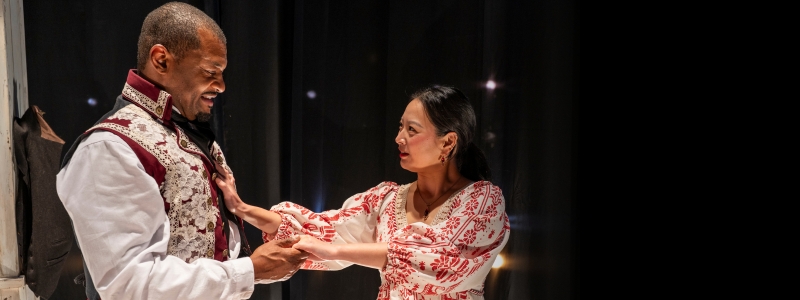
On the heels of Marti Lyons’s The Taming of the Shrew, Miss Julie joins the rest of Court’s season in asking its audience a series of questions about the theatrical punishments of women and the deployment of bodily practices (whether BDSM or dance) to query inherited representations of feminine bodily expression.
In 1888, modernist titan August Strindberg’s stated goal in writing Miss Julie was to revolutionize the theatre. It was published alongside an infamous preface, which has come to be known as Strindberg’s manifesto for a new Naturalist theatre. The titular protagonist, whom he describes as a “half-woman,” “man hater,” and “a type who thrusts herself forward, selling herself nowadays for power, decorations, distinctions, diplomas, as formerly for money,”1 is a recently jilted, aristocratic young woman. She rushes from a country dance into her family manor’s kitchen on a summer evening and pleads with her absent father’s valet, Jean, to dance with her. As the two have an increasingly wine-soaked discussion across class, sex, and gender, a dark tragedy takes hold of the evening, resulting in the beheading of a small greenfinch and Julie’s suicide, abetted by Jean. From the play’s first lines, “Miss Julie’s crazy again tonight; absolutely crazy!,” to the summer ball thrumming offstage, to the cook’s frying and sizzling in the kitchen where the entire drama unfolds, the play announces itself at a hysterical fever pitch. When Julie comes down to elope with Jean, bringing with her only her greenfinch in a cage, he beheads the bird, and, just as her absent father is due home, she appears to lose her mind entirely. Julie plays the part of femininity’s dangerous wishes: her jilted hysteria, her failed taming of men, and her hereditary “degenerate” nature are what seem to lead her to “suicide.”
Degeneracy—defined in this play as Julie’s unregulated need for dancing and bodily expression—was key in Strindberg’s lexicon. As a manifesto for a new theatre, Miss Julie focused as much on new staging and lighting ideas as it did on a completely new paradigm for drama: no more stock characters whose experiences were limited by mask-like clichés and predictable tropes. Instead, an event like Julie’s suicide must be shown in the “multitude” of its animating psychological dynamics, degeneracy leading among them. Strindberg wrote, presciently, “It seems to me that the psychological process is what interests people most today. Our inquisitive souls are no longer satisfied with seeing a thing happen; we must also know how it happens. We want to see the wires themselves, to watch the machinery.” As “modern” characters, Julie and Jean are two studies in late 19th century psychology, where the “soul” has to be represented as a “complex of motives.” Strindberg wanted to avoid tropes and physical gimmicks, trying instead to provide an “objective” take on an event like Julie’s death. And yet, his characterization of the “degeneracy” of modern women like Julie betrays an anxiety about what he calls Naturalism’s “desperate fight against nature,” where “nature” is assimilated to women’s bodily excesses. It reproduces its own kind of misogynistic trope, a proposal any 2026 production of the play must interrogate, since Strindberg landed on the sinister notion that a “sound species,” rid of “degenerates” like Julie, was required to achieve collective, social “happiness.” In what ways did Strindberg’s aspirations for a new theatre only work to naturalize an old cliché? And what are theatre-makers now to do with these problems?
For a play that seeks to center psychology, Miss Julie is oddly haunted by the sweaty spectacles more readily associated with embodiment. Dance troubles theatre’s psychological naturalism by threatening to drown out a scientistic study of human behavior. Strindberg knew this, and his f irst gesture was to banish the Midsummer revels offstage, as if to keep bodily spectacle at bay so that a psychological power struggle can unfold. Director Gabrielle Randle-Bent, however, plays with the porous nature of the boundary between the dance outside and drama within as if to heighten the formal trouble dance presents. After Court audiences get a privileged glimpse of Strindberg’s banished Midsummer revelry, Julie relentlessly attempts to convince Jean to come back out and dance with her. Jean replies: “I wonder if it’s wise for you to dance twice running with the same partner, especially since these people are quick to jump to conclusions….” Their debate parses the disastrous implications of being seen dancing together and crossing the strictures set by class and gender.
How the chorus interprets Jean and Julie’s dance is a matter with devastating consequences both for Julie and for Miss Julie. This production asks us to grapple with similar questions of interpretation. Strindberg was as much seduced as he was repelled by the bodily forces of dance. His ambivalence about its peripheral but potentially devastating impact makes his dancing bodies difficult to reclaim, in particular in this hysterical rendition. What are we to make of these forms and their associations to female madness? Managing what dance means—what its powers and perversions are—frays the hard edge of the “new” theatrical naturalism Strindberg sought to establish. By first banishing dance, he paradoxically amplified its unspoken presence and heightened its strong correlation with taboo. But it’s not merely that the Midsummer revels are ongoing just beyond the stage; Strindberg also includes a mimed movement sequence for the cook Kristine’s domestic labor—“leaving here an even wider scope for the actor’s imagination, and more chance for him to win independent laurels”2—and a formalized Ballet in which the chorus of country dancers finally enters the kitchen, reviling Jean and Julie for dancing (or sleeping) together. Even Jean and Julie’s erratic, overlapping language is choreographic: Julie has nightmares of falling from pillars and is cautioned against “stepping down,” that is, dancing with people beneath her station. Jean’s aspirational dance is instead a leap upward, a desire to “soar” above the trees, to raise himself above his station. In this collision between upward and downward trajectories, in the push and pull between Strindberg’s desired objectivism and dance’s dangerous embodiment, the tragedy finds its combustive energy.
Strindberg might not have intended his play’s relentless focus on the dancing body. Yet Miss Julie works through an immensely popular and longstanding set of questions about “dangerous” women who move, feel, and express through embodiment. The play is in fact a forthright retelling of the biblical tale of John the Baptist’s execution by Herod Antipas, otherwise known as the story of the murderous girl-dancer Salome. At the time of Strindberg’s own writing, a veritable “Salomania” had taken hold of European theatre.3 We can read Strindberg’s play as his own version of the tragic dancer that would clear a passage for a new aesthetic form. As the gospels of Mark and Matthew narrate, John was held prisoner at Herod’s court. On Herod’s birthday, a young girl is brought out to dance. Having pleased the king, she is authorized to ask for whatever she wants. She asks for John the Baptist’s head. John is beheaded. In Strindberg’s retelling, dancing risks similar consequential decollations—though John/Jean comes out unscathed; it is Miss Julie’s goldfinch who bears out the myth. Instead, Miss Julie explicitly avenges the male martyr and punishes the female dancer. Perverting the tale of Christian martyrdom, Miss Julie takes the biblical dance and turns it into a pressure cooker for Strindberg’s modern associations between gender, class, and psychology. Are we indeed to believe that “Miss Julie is crazy!” as advanced by the evergreen assertion that she wants too much from dancing? Is her dancing a mere symptom of her decadent aristocracy and corrupt gender? Or are we rather to take up Strindberg’s Naturalist method for interrogating the association of the (female) psyche with the problem of degenerate embodiment? Does dance, in the background, allow us to think of Julie’s interior life and capitulation differently?
Strindberg’s Julie hates men—and this quality is, per his evolutionary Naturalism, hereditary. Tragic, in this way, too. We are told early on that Julie was jilted by her fiancé for trying to “make him [her] slave.” Just like Kate in Shrew, Julie is a tamer tamed. Here, in its modern rather than pre-modern version, she is a wild dancer choreographed into submission. Julie’s death is just another capitulation—not quite placing her, like Kate, “below her husband’s foot,” but demanding something more gruesome: that Jean order her to slit her own throat. It is not her tongue, ultimately, that takes her down, but rather the suppression of her wily bodily agency, banished like the dances that threaten the naturalism of Strindberg’s new theatre.
CJ NIZARD (she/they) is a joint PhD Candidate in English and Theater and Performance Studies researching the hatred of dance. They are also an editor and performer, and have shown work in the UK, USA, and Canada.
- See Playwrights on Playwriting: From Ibsen to Ionesco. Ed. Tony Cole. Cooper Square Press, 1960. ↩︎
- All citations are from the preface. ↩︎
- See for example Gustave Flaubert’s 1877 Trois Contes, Jules Massenet’s opera Hérodiade, Oscar Wilde’s 1891 play Salomé, and the choreographies of Maud Allan and Loïe Fuller at the turn of the century. ↩︎