Post-Show Classroom Activity
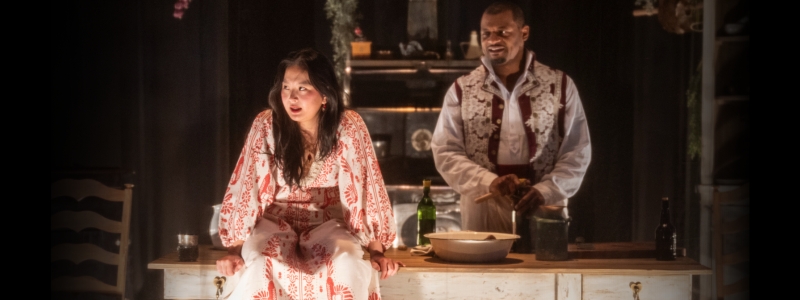
Invite students to play Evolution and discuss themes of social mobility in Miss Julie.
As always, please note that some steps of the activity may be condensed, eliminated, or extended based on the needs of your classroom.
Social Climber
Activity Preparation
- Set-Up:
- The game Evolution benefits from some open space for students to move around. As needed and able, clear some space in the classroom.
- Consider any adjustments that need to be made for this game to accommodate students’ physical or mobility needs.
- It might be useful to display for students the different levels of the game—egg, chicken, dinosaur, human, superhuman—by writing them on the board. If a group is less comfortable with theatre games like this, have them try out the physicality of each “level” of evolution first as a class.
- Establish for students that each time they play rock paper scissors, they should throw down their choice on “shoot.” (“Rock, paper, scissors, SHOOT!”) You may also wish to have students play for the best out of three for each matchup.
- Use your discretion to determine when the game will end for the needs of your particular group, if this differs from the instruction below.
This activity will take approximately 30 minutes.
Learning Sequence
- Tell students they’re going to play a game called Evolution. Explain that each student will start out as an egg. To show that they are an egg, they will crouch on the ground with their hands over their head in an egg shape. If they level up to become a chicken, they stay crouched, move their arms like wings, and make their best chicken noises. If they level up to dinosaur, they stand up, holding their arms like a T. rex and making dinosaur noises. If they level up to human, they should walk normally, swing their arms, and hum. If they level up to superhuman, they hold up their fists like Superman and mimic flying. (~3 minutes)
- Tell students that they level up or down by playing rock, paper, scissors with someone at their own level. The person who wins moves up in the evolutionary line, and the person who loses moves down (ex: if two chickens play, the winner becomes a dinosaur and the loser becomes an egg). The game ends when a particular number of students (teacher’s choice, though we suggest about 20%) of the class achieves the level of superhuman. (~2 minutes)
- Have students spread out evenly across the room in a wide, clear space and pair up with one other person. Remind them that they all start as eggs and have them begin playing rock, paper, scissors. Monitor the class to help students find people at their same evolutionary level to pair up with and challenge. If there’s time and interest, facilitate multiple rounds, or create new rules, such as that every superhuman must continually challenge each other so that only one person is at the “top” for any given amount of time. (~15 minutes)
- Guide students to return to their seats and debrief. Ask: How did playing this game feel? What did it feel like to climb the ranks or get demoted to a “lower” level of evolution? If anyone became the only one at their particular level, what was that like? (~5 minutes)
- Bring Miss Julie into the conversation. Remind students that Miss Julie found it easy to “forget about rank” since she was privileged, while Jean obsessed about having more money and influence. Ask: How does class impact how you move in the world and what your priorities are? (~10 minutes)
- This activity aligns with the following standards:
- Illinois Arts Learning Standards
- Anchor Standard 7: Perceive and analyze artistic work.
- Anchor Standard 8: Construct meaningful interpretations of artistic work.
- Anchor Standard 11: Relate artistic ideas and works with societal, cultural, and historical context to deepen understanding.
- Common Core State Standards
- CCSS.ELA.R.3: Analyze how and why individuals, events, or ideas develop and interact over the course of a text.
- CCSS.ELA.SL.1 Prepare for and participate effectively in a range of conversations and collaborations with diverse partners, building on others’ ideas and expressing their own clearly and persuasively.
- CCSS.ELA.W9 Draw evidence from literary or informational texts to support analysis, reflection, and research.
- Illinois Arts Learning Standards