Pre-Show Classroom Activity
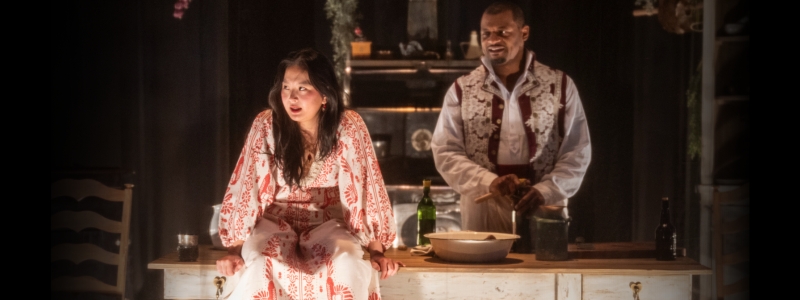
Invite students to dive into the work and impact of Hans Christian Andersen on Miss Julie, and then create their own modern fairy tale.
As always, please note that some steps of the activity may be condensed, eliminated, or extended based on the needs of your classroom.
….And They Lived Happily Ever After
Activity Preparation
- Supplies:
- The Swineherd (Audio Recording) (11:50)
- A clear space for staging student-made fairy tales
- Paper/pencil (optional)
- Set-Up:
- Note that playing the audio story of The Swineherd will add about 12 minutes to the activity. If choosing to summarize the story for students, prepare by familiarizing yourself with it ahead of time.
- Consider pre-planning the small groups in Step 4.
- Each small group will have one narrator. Consider whether other roles might benefit your students, such as a scribe (who is responsible for recording the plot points of the story) or a director (who provides guidance for the acting out/tableaus in Step 4).
This activity will take approximately 50 minutes.
Learning Sequence
- Invite students to share the names of some fairy tales that they are familiar with. Ask: Why do you think people are drawn to them/re-adapt them so frequently? What purpose do fairy tales serve? Look for answers such as “To share morals” and “Teach lessons that are timeless.” Share with students that fairy tales are usually life lessons made palatable for children, but they also often feature dark themes and upsetting events. Invite students to consider any fairy tales they are familiar with that might contain dark themes (ex: in the original Cinderella tale, the stepsisters hack off parts of their own feet to fit the glass slipper). (~5 minutes)
- Explain that Miss Julie is loosely based on one of Danish writer Hans Christian Andersen’s tales, The Swineherd (he also wrote such famous stories, such as The Little Mermaid). Play an audio recording of the story. Invite students to name some themes or morals in the story. (~15 minutes)
- Inform students that playwright August Strindberg took the inspiration of The Swineherd and used it to write a play that is a commentary on class and gender roles. Share that this play has been produced somewhere in the world every single year since it was written—over 100 years ago! Note that this suggests that the morals and lessons in The Swineherd and Miss Julie are worth revisiting even today. Ask: What fairy tale do you think is relevant to the world right now? What themes/characters resonate with you? Brainstorm a list as a class. (~5 minutes)
- Divide students into small groups of 3 or 4 students. Have each group identify an issue in their school or in the world that they would like to change. Then, have them create their own modern fairy tale. They may use an existing fairy tale as inspiration, or invent something totally original. If students are struggling to brainstorm ideas, point them to the lists they generated in Steps 1 and 3. Each group should have a narrator who relays the entire story while the rest of the group acts it out. Each story should have a clear beginning, middle, and end. Students may mime the actions of the story along with the narrator, or present a series of tableaus (frozen pictures). They may wish to use paper and a writing utensil to plan out their story. (~10 minutes)
- Have each group share their fairy tale. Invite students to ask questions about each presentation, and identify the moral of each story. (~15 minutes)
- This activity aligns with the following standards:
- Illinois Arts Learning Standards
- Anchor Standard 1: Generate and conceptualize artistic ideas and work.
- Anchor Standard 6: Convey meaning through the presentation of artistic work.
- Anchor Standard 11: Relate artistic ideas and works with societal, cultural, and historical context to deepen understanding.
- Common Core State Standards
- CCSS.ELA.RI7 Integrate and evaluate content presented in diverse formats and media, including visually and quantitatively, as well as in words.
- CCSS.ELA.RI1 Read closely to determine what the text says explicitly and to make logical inferences from it; cite specific textual evidence when writing or speaking to support conclusions drawn from the text
- CCSS.ELA.W.3: Write narratives to develop real or imagined experiences or events using effective technique, well-chosen details and well-structured event sequences.
- Illinois Arts Learning Standards