In Conversation: OUT HERE
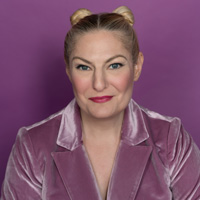
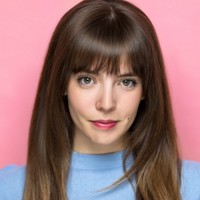
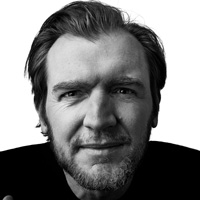
As anticipation built for the debut of Out Here, three ensemble members—Becca Ayers (Dawn), Ellie Duffey (Cleo), and Cliff Chamberlain (Brian)—sat down to discuss their journey with the new musical, Below is an excerpt of their conversation.
How long have you been attached to Out Here?
Becca: I’ve been attached to the project since summer 2025. I was doing summer stock in New Hampshire when I put myself on tape, and my audition was a very wordy song. (Don’t tell, but I used a teleprompter!). I was told I was going to have a meeting [about Out Here], but then my manager tricked me and said, “Bad news, they cancelled the meeting … because you got the job!”
Ellie: I’ve also been tied to the project since the beginning of last summer. It was a crazy time: I was in finals, I was graduating college, I was moving apartments, and I was doing Berlin at Court while the audition process was going on.
Cliff: I have been officially attached since last summer. I did a workshop of Out Here about three years ago, in the summer of 2023 at the University of Chicago. I actually don’t know what stage of the process it was in—pretty early on, I think.
Have you been involved in developing a new musical before?
Cliff: I haven’t been in any process of any musical ever, so from the get-go to now, I am absolutely in uncharted territory.
Ellie: Same here. I really don’t do a lot of musicals—or it’s not something I see myself doing often. I participated in some early workshops for student-written pieces in college, but nothing like this.
Becca: Yeah, I’ve done a bunch. There’s a children’s theater company called TheaterWorks USA, and they always have really amazing writers. I’ve been involved in a lot of their developmental workshops, including one that Kristin Anderson-Lopez wrote, who went on to do Frozen. Another was called Sarah, Plain and Tall, by Larry O’Keefe and Nell Benjamin, who went on to do Legally Blonde (both O’Keefe and Benjamin), Heathers (O’Keefe), and Mean Girls (Benjamin). Then I did Dogfight and Giant off-Broadway. I’ve done a lot of readings and workshops, too.
Ellie, you appeared in a new work last season at Court—Berlin. Did your experience with Berlin influence your preparation for Out Here?
Ellie: Berlin was different because there was an established world already—600 pages of backstory in Jason Lutes’s graphic novel. Originating a role happened there, but not in the same way. With Out Here, we’re building from the ground up. Everyone comes in with different levels of excitement and confusion, and that’s super exciting.
How do you approach learning music for a new musical?
Cliff: My 14-year-old daughter is teaching me how to read music. I can’t read music, so I learn by ear. The creative team is incredibly supportive and patient, offering tracks for us to follow. Everyone’s guidance and artistry makes it easier for those of us who don’t usually do musicals to succeed.
Ellie: I honestly don’t read music either; I learn by ear. For me, as long as I hear it enough times, I can get there.
Becca: That’s how I learn too—by repetition.
What was it like to learn original music and adjust to rewrites?
Becca: I don’t mind it. I like not having anyone else to compare myself to since I’m the first one performing the role in a full-fledged production. For me, it’s repetition—listening to the songs as much as I listened to Into the Woods when I was 15.
Ellie: Original music is exciting—auditioning with a new song, seeing the creators excited as their work comes to life. Being in a new show is thrilling, especially as the script keeps changing. It feels like a team effort. There’s a lot of adrenaline in the room.
Cliff, any lessons learned from the different phases of development?
Cliff: The biggest lesson is just how talented the artists at all stages of development have been. It’s inspiring to see songs change, move, get edited or even replaced—all to support the story. The musical really focuses on Dawn’s journey—about family and divorce, but ultimately her story. Different actors and artists have contributed, and the creative team has grown the story from every iteration. It’s like breaking in a pair of boots—each time, they fit a bit better.
Becca and Ellie, what drew you to your roles?
Becca: When I read the script, I had never felt more seen. It was so relatable, right in my wheelhouse. I went to a women’s college, I identify as pansexual now, and the character is a conglomeration of my friends. I was excited and started sharing things with the creative team—pictures from college, old memories. The story really resonated.
Ellie: A lot of the show is about Dawn, but I connected to Cleo’s generational perspective. Her mother is coming out to her, but for Cleo, her mom’s identity isn’t complicated—she simply supports Dawn. The challenge is understanding the deconstruction of family and how family changes. I’m excited to help tell Dawn’s story.
The show’s depiction of family is expansive—how does that resonate with you?
Ellie: I was lucky to have a lot of supportive adult women in my life in addition to my mother. The show explores that idea that family isn’t just the nuclear unit—more people in your village means more support.
Becca: My ‘chosen family’ that I met in college are still a huge part of my life. Their kids call me Aunt Becca and I am their godmother. I’m nonbinary. When I was growing up, I didn’t know what non-binary was.
Is this musical a coming of age story?
Ellie: Yes, but not necessarily in the way you’d think. You get to watch your mom come of age. There’s generational downloading throughout the piece; everyone goes through growing pains, but it manifests differently for each character.
Cliff: I am a child of divorce, and I’m a husband and a father now. What I really love about this musical is that Brian’s challenge isn’t about accepting Dawn’s authentic self. He’s actually supportive of that part of her. What’s hard is losing his wife and the change in the family unit.
There’s a lot of love in this musical—you can feel it in the bones of the show and in the characters. There’s miscommunication and hurt, and times when frustrations boil over, but it’s all steeped in a sense of love, acceptance, and a challenge to be our best selves. There might be moments when the characters are mean, but there’s no cruelty.
Eliminating cruelty is something my wife and I are adamant about, both in the world and in raising our kids to be compassionate human beings. Thank goodness my kids are all big-hearted, lovely people. We’re trying to create human beings who have compassion for their fellow people, and I think the musical has that all over the place. Sorry, I get emotional talking about my kids and this kind of thing.
Becca: When I hit 40, it felt like suddenly my only audition opportunities were for witches or invisible moms. I started writing so I could be represented and create opportunities for marginalized people. I am beyond grateful that the character of Dawn is so seen, so complex, and is exploring new territory yet to be experienced by a musical theater audience.
Ellie: I’ve been thinking about the shift that happens in your teenage years, when you start to see your parents as three-dimensional people who are flawed. I think that moment happens a lot for Cleo, and instead of shying away from it, she approaches it with compassion and curiosity. I think that’s true for all the characters in this play—they run forward with compassion.
How does it feel to originate a role?
Becca: It’s so exciting to be in the room with the creators and to get information that helps illuminate the character first-hand. We get to create as a team, which is a gift I’m extremely grateful for.
Ellie: It feels more personal—you get to bring different aspects of yourself into the character, and by the end, a full-fledged person emerges.
Cliff: Most of the work I’ve done in Chicago has been new. I’ve been super lucky to be a part of many new projects. It’s always really rewarding to be in the room with the creators—to watch them, to be part of something happening for the first time. It’s rewarding to put my spirit into a project, knowing it’ll be there forever.
Why should audiences come see Out Here?
Becca: Everyone will find something to relate to in it. It’s about family, communication, compromise, getting through hard times and it’s very real.
Cliff: It’s the musical we need in 2026. The story, characters, and journey have heart. It’s a piece of art that belongs to this time, encouraging people to go out into the world and be better.
Ellie: This new sort of musical storytelling is exciting. It’s people running toward each other with compassion. We meet each other with different experience levels and run toward each other with compassion as artists.
Cliff: The book is great. The music is rockin’, and all the performances will be, too.
Ellie & Becca: Yeah.
Out Here is on stage at Court April 10 through May 10, 2026 → Get tickets.