An Abridged OUT HERE Dictionary
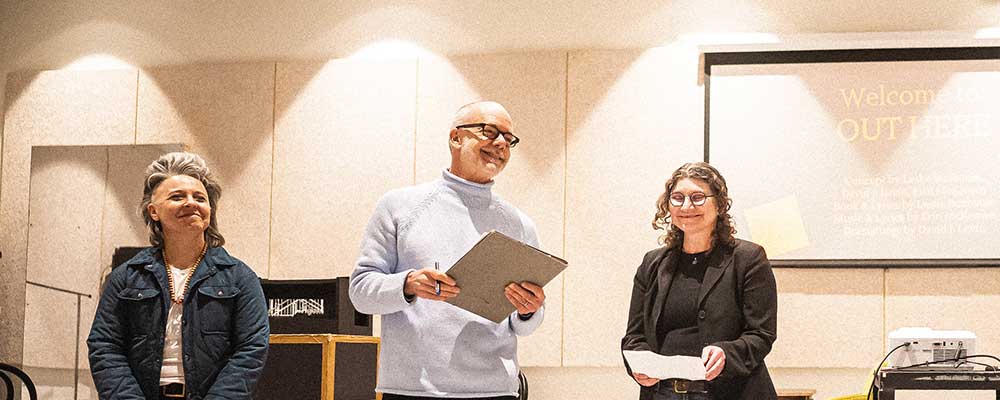
at first rehearsal for Out Here (Photo by Joe Mazza).
In this brief essay, I want to introduce two terms —undo-sical and tripod—that emerged over the course of our work on Out Here, terms that I hope will help to explain how the piece works and how we worked on it.
When Leslie Buxbaum, Erin McKeown, and I first started collaborating on this project back in 2022, we referred to it not as a musical, but as an undo-sical. Our thought was that musicals are generally characterized by a conventional alternation between speaking and singing. In Out Here, we wanted to explore that alternation, play with it, de-conventionalize it, even undo it. At the same time, Out Here tells the story of an undoing and redoing of a family and a set of relationships. We wanted to bring these two components—our formal interest in undoing and redoing the relationship of speaking and singing; and our dramatic interest in telling a story of undoing and redoing relationships—into dialogue with each other. Characters in the world of Out Here wonder about their relationships to each other, and they wonder about how they might best express those relationships—and they do that wondering in spoken words, and in song; and at times they even do it about spoken words and song. Which is to say, they wonder whether what they’re saying might be better said—whether it might be more expressive, more convincing, more successful—if it were sung, and vice-versa.
There are a slew of other noteworthy components of formal play in the piece that follow from this fundamental commitment to playing with the distinction between singing and speaking. One of them comes from a core tenet of Leslie’s many years of work in the theater: the idea that we are all right here, in the theater, right now. In Out Here, this core tenet allows us to play with the multiple meanings of “house.” Since a house is a home (like the house that we see on stage), and in theater parlance, it’s also the theater (so that, the “front of house,” for example, is the auditorium and the foyer). By this logic, the actors that we encounter on stage in Out Here are in a house; but by extension, so too are we, in the audience, in Court Theatre’s house. Likewise, in the piece, we play with competing expectations of theatrical reality and the reality of everyday life. And we’re keen to explore the distinction between the stage as a theatrical world unto itself, and its physical status as a space shared with the audience, and thus, as an extension of the real world. There are some additional corollaries of this interest in play—involving time, for example, or the piece’s linear progression. They all derive from our core commitment to exploring the relationships at the heart of this piece right here, in the theater, with these performers, and with you in this audience, right now. For everyone in the world of this piece, undoing is a heady and a serious thing—it involves tremendous courage, and it’s also fraught. But undoing is also a space of tremendous opportunity, of utopian reinvention, of unfettered imagination.
Which brings us to the second entry in this highly abridged dictionary. If you happened to take a look at the credits at the top of your program handout, you may have noticed that Out Here is the product of a collaboration between Leslie Buxbaum, Erin McKeown, and me. Over the course of the collaboration, the three of us came to refer to ourselves as the tripod. (Court’s Associate Artistic Director Gabby Randle-Bent suggested the moniker in an early production meeting—and it stuck.) And before you roll your eyes—or maybe while you roll your eyes—let me explain.
It’s not like the configuration of our work is self-evident. Leslie was responsible for Book and Lyrics, Erin for Music and Lyrics, and I for… what? Concept? Right there we start to glimpse the complications—and the show’s cumbersome credits reflect this.
"Each of us speaks a different performance language, and we’re each of us curious about how the other two speak, with a deep admiration for the differences and overlaps in our formulations and perceptions."
Essentially, for the past four-plus years the three of us have been engaged in a fluid dialogue that crosses many of the traditional boundaries of a collaborative team. Not that we’ve all been doing everything. Erin is definitely the composer (but Leslie and David have lots of musical ideas). And Leslie definitely wrote the original script—and is responsible for the book (but Erin and David have lots of script ideas). And I have lots of thoughts about the importance and pleasures of formal play, and the delights of unpredictability, in musicals, and in performance more generally (but so too do Leslie and Erin).
Over the course of these four years and most especially for the past six weeks, the three of us have been collaborating on all the things, thinking together about the book, the music, and the piece. Concretely, this means that we live a good part of our lives in a shared Google doc, that has served as our ‘script’ hub throughout the process, with a nonstop dialogue in the margins.
Each of us speaks a different performance language, and we’re each of us curious about how the other two speak, with a deep admiration for the differences and overlaps in our formulations and perceptions. It’s surely not the most efficient way of proceeding. But we’ve found it to be generative. And since it was cumbersome to always say “Leslie, Erin, and David,” the tripod captured the aspiration to a fundamentally balanced collaboration that has characterized our work. According to Wikipedia, a tripod is “a three-legged stand or frame that supports various objects, such as cameras, telescopes or cauldrons.” Which is to say that the tripod makes it possible to perceive objects very close at hand and very far away, and it likewise makes it possible to cook things up together.
We are so excited to welcome you to the world of this undo-sical, and to see it come to life on Court Theatre’s stage with this amazing cast, and all of the extraordinary artists contributing behind the scenes. And we are especially excited that you are joining us for the adventure.
Out Here is on stage at Court April 10 through May 10, 2026 → Get tickets.