No Small Plans
KRISTEN KAZA IN CONVERSATION WITH KAMILAH RASHIED
In this conversation, Director of Engagement Kamilah Rashied sits down with cultural producer Kristen Kaza to discuss the evolution of her career and the founding of her company, No Small Plans Productions. Kaza established the company to bridge the gap between major institutions and Chicago’s independent artists, guided by the ethos of “parties with a purpose.” This intentionality is a vital through-line for Court Theatre’s current public programming, which echoes the themes of the new musical, Out Here, by centering queer intergenerational storytelling and the power of the first-person narrative.
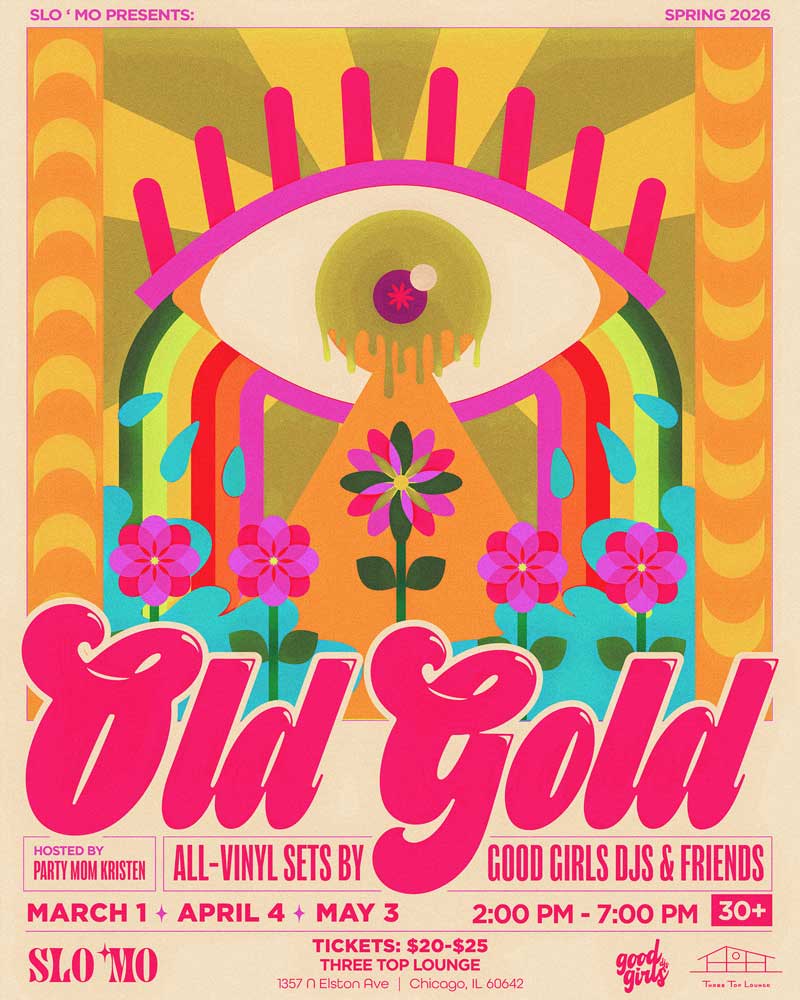
Across her body of work, Kaza emphasizes the necessity of cultivating spaces for belonging, fostering intergenerational queer connection through events like Old Gold (an LGBTQ+ day party for the 30+ community) to her current focus on the intimate, firsthand documentation of her own life and motherhood as part of her in progress memoir project, Mother Lover.
Kamilah: How did No Small Plans Productions come about?
Kristen: I was working at the Chicago Reader at the time, producing events, and creating more of a connection between readers and community, and the paper, which of course was an institution, had gone through quite a bit of tumult after almost 40 years of being independent. It was my first time there, supporting a transition [for the paper to] be purchased by the Sun-Times. It gave me a lot of experience working with Chicago artists and organizations, being that it’s such a Chicago- centered media publication.
That’s just something that I wanted to do and double down on more, noticing that so many events and programs and lineups were built for vendors and artists that weren’t from Chicago. Seeing such a dearth of presence of women in lineups in music in particular, because that’s the artistic space that I move in the most. I started No Small Plans because I really wanted to help be that bridge between institutions, brands and independent, emerging artists and small businesses in Chicago. You know my No Small Plan slogan is “parties with a purpose,” and really focuses on intentionality scaffolding events.
Kamilah: That’s beautiful. I don’t know that I have ever heard it described that way, but it makes so much sense, because your events have run the gamut, but have always had a very civic thread, which I admire as a producer and administrator. I think queer spaces and third spaces for socializing or partying have always been inherently political, but I really appreciate the way you’ve made that thread explicit.
Kristen: Yeah, you can’t separate it, right? And it’s a very interesting line to walk when you’re working with institutions and corporations—trying to usher them along, but also not being the final decision maker when you’re a contractor. So when I am doing these collaborations that’s something that I think that I have, over time, really honed a very special skill in. It’s a lot of responsibility, because you have artists and small businesses who are trusting you to advocate for them, and then you have these brands and institutions who are having you go back to those businesses and artists when you have to make negotiations or say no. It’s a very auspicious position to be in between the two and something I have a lot of pride in. It amazes me [how far we’ve] come [on] these projects.
They would have vendors or artists there flying in DJs from other cities, or working with the biggest caterers in the city. We don’t have to do these things this way. These are the types of gigs that really open the doors for these [local] businesses and artists. Especially working with so many institutions in Chicago, like the MCA, Navy Pier, or DCASE, it’s so critically important that new people are being able to have an opportunity in those spaces. Because a lot of times these are artists and vendors and small businesses who don’t have a lot of that experience, that’s also [an important] role, as a producer and facilitator, to not abandon them when they get that opportunity, because that’s often when things go awry too, right?
[Some] people haven’t had the opportunity, or the skill, or the investment, and they’re not really set up for success. I think as a producer, when I’m a collaborator with different brands and institutions, that feels like a really important role [to play]. And it’s not necessarily different when I produce my own events. But there’s an elevated pressure and intentionality when I’m the lead on a concept, because I am the one bringing people to the table.
Over time, I’ve just tried to really focus on how to look at equity in a really comprehensive way, and take accountability for the fact that if you are a producer, you are taking on a lot of responsibility and risk, and that risk can come with great reward— it can also come with great vulnerability. How do you scaffold your event with partners where there’s transparency and understanding in how things are going to flow.
So much nuance. And also making sure that you’re not overcompensating. That’s something I’ve found myself doing constantly. When you are an advocate for people that you’re bringing into something, your reputation is on the line. Being very clear with those people [about] what the project means to you and what your role is and vice versa. If you are a small business or an emerging artist working with a giant budget or a larger corporation or company, the project could mean so much to an emerging artist or business, and for [the client it could be] a tax write- off or for press. There’s a lot on the line when you’re a small business or an artist, and these types of gigs are your stepping stone.
Kamilah: I take that personally. I internalize that a great deal in my work. A lot of my job becomes turning towards the organization, as an advocate of our community and arts partners, to explain the ways that I need to work to really honor them. Many of the people that we partner with are not part of big institutions that have resources or time to lose.
What other values, interests or curiosities have guided your work? With all the different hats you wear as an event producer, a convener, an advocate for the queer community. What’s driving you?
Kristen: My desire to cultivate and be a part of cultivating spaces of belonging. I think at the end of the day, we seek out these spaces to have a sense of belonging, you know? And I think that’s why third spaces are being sought out [right now], because people aren’t getting that feeling of belonging online. It is presented as this very shiny thing [that] gives you that quick dopamine [hit], and people are realizing this is not sustainable. So they’re seeking out third space because they want meaningful connection.
One of the skills that I’ve honed over time, something that’s important to me, is what is your experience going to be then? What [does] belonging mean? Something different to everyone. Inclusion is really aspirational, right? Because there’s no way that you’re always going to be able to know and then accommodate every person’s need that walks in. But it’s really [the] small things that make that difference. For example having moved through pregnancy as a party promoter. I wanted to see more pregnant people and parents in the club and feel like they belonged there. Sometimes you just need to be able to have a seat, you know? And so we started having a statement that said, if you have mobility challenges, if you’re pregnant or postpartum email us, and we’ll reserve a seat for you. It’s just this small signal that says, I’m thinking about what your experience is when you come here. A lot of times booth seating is for bottle service. Sort of flipping that and saying we’re actually keeping the space for people that need the support the most. The kind of feedback that I got for that has been really powerful. It’s just this small signal that says, I’m thinking about what your experience is when you come here.
Kamilah: You’ve been really candid about a growing desire to document your own experience and your own life. Why does documenting your life feel important at this point in your creative life and career?
Kristen: Thank you for asking about that. On a deeply personal note, I’m hardwired to orient around the needs of the collective. Something my dad says is your greatest strengths are your greatest liabilities, so that’s a great strength. Oftentimes, though, the compromise was at my own expense, so that was the liability of it. I think I’m in a time now where I’ve never been so close to riding the line of my own capacity. Prior to children, I could just keep going and going. There was always a cost. But the stakes are so different now that I have people depending on me that I go home to.
So I have to make different kinds of choices. Even before I had children, I’ve always worked [through] this maternal lens, an expansive approach for care and inclusion, and including as many people [as possible]. Representation, especially in lineups, but also in making sure people’s voices were heard, [that] their feedback was heard. I think in this new era of work that I’m hoping to move into, writing requires me to be honest, especially creative nonfiction and memoirs.
A lot of my work before has been how do I edit this so that I’m not completely leaving myself out, but from a public point of view, still prioritizing the collective. Writing is an opportunity to focus on and share [more of ] my interior. I have been open about my life and my experiences and the fact that I’m a mother now, and I have children. But I haven’t yet really been able to show up in this new era of my life. [When] people are really used to you performing at a certain level, it can be difficult to adjust to that. Writing is very vulnerable, and I haven’t established that practice just yet because of my capacity, and because of my orientation around getting things so correct.
Writing really requires you to be very honest. Especially if you’re talking about things that are so personal and nuanced, like motherhood and balancing the different roles that we have, and talking about grief and growth. I just feel really called to that, because I think I’ve, quite frankly, sidelined it a lot in life.
[I’ve] amassed a lot of experiences. Being a mother, pregnancy, forming a family, we have a very non-traditional family, and we’ve been very open about that. I would like to take that more into the public and give that more space to be tended to. I think that I have given quite a lot to nightlife and entertainment over these last two decades in Chicago.
I’m not moving away from that, because I just love identifying a need, that has been a strength of mine, and why some of these projects have really flourished. It wasn’t completely a unique idea to have a queer family-centered festival [like the Queer Fam Pride Jam], but it didn’t really exist yet in Chicago. Not with someone that’s a leader that knows how to really facilitate space, right? [It was the same] with Slomo, which certainly was not the first event to have a more R&B-centered, mid- tempo dance party, but what it did was really pull from things that we know are timeless. So people felt such a connection to that party [because it was] refocused on intimacy.
I find myself wanting to go back to having that intimacy because of how it allows for more intentionality and conversations and honesty. We’re in such an era of fakeness between not knowing what’s real and fake with AI and with mass consumption, and the even further bloating of corporate monopolies. We’ve got to get back to intimacy again. My hope is that with a writing project and creating that through my new project, Mother Lover, [I can] weave that in with my public event practice and get back to that kind of nostalgia.
Legacy building and legacy weaving are super important to me [as well], and that’s why, if you’re paying attention, you’ll see that history is a part of most of my projects. Honoring the stories that are not always told, focus on women in music, Black women, and queer and trans women in music, because, hello? They are often the arbiters of the greatest culture, and those stories aren’t told. But it has to go beyond the storytelling, it also has to be in the investment, and that’s something I’ve learned over time. How do you become a great co- conspirator? If you’re the one that’s holding more privileges, it usually comes down to access. It’s a really important role you have to take seriously when you are the conduit, because someone is trusting you.
When you go to a party like Old Gold, and you have four women that DJ together, that are in the age ranges of 30s, 40s, 50s, and 60s, that have over 70 years of collective experience, there’s [inherent] impact, because it’s less about a trend, [and more] about them showing up and being their authentic selves and doing something that they really love. When you remove some of that other bullshit, oftentimes connected to patriarchy, it just [provides] a lot more room to be yourself and express yourself. That’s why Old Gold, the party I am continuing, is really important to me.
There’s an intersection of representation there that we shouldn’t have to call out and say, oh, it’s an all-women thing, because you don’t have to share those identities to advocate for them.
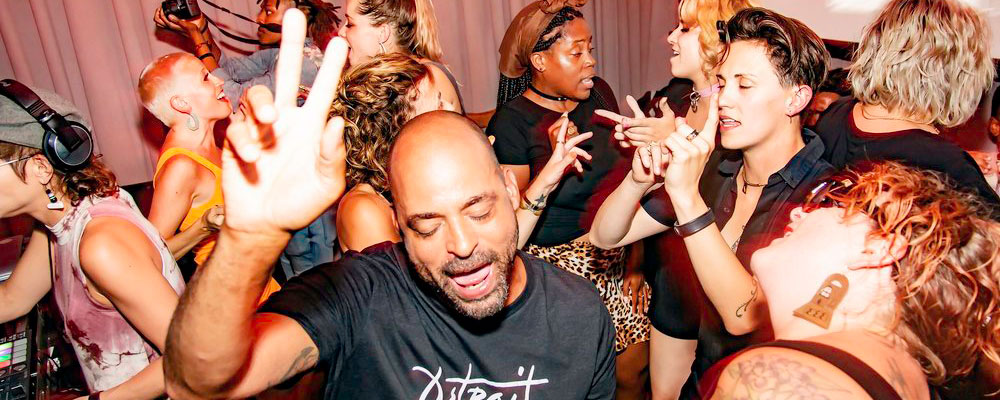
Header image: The Whistler cocktail bar, the first home of Slo ‘Mo: Slow Jams for Queer Fam (2019, photo by Erik Michael Kommer).